


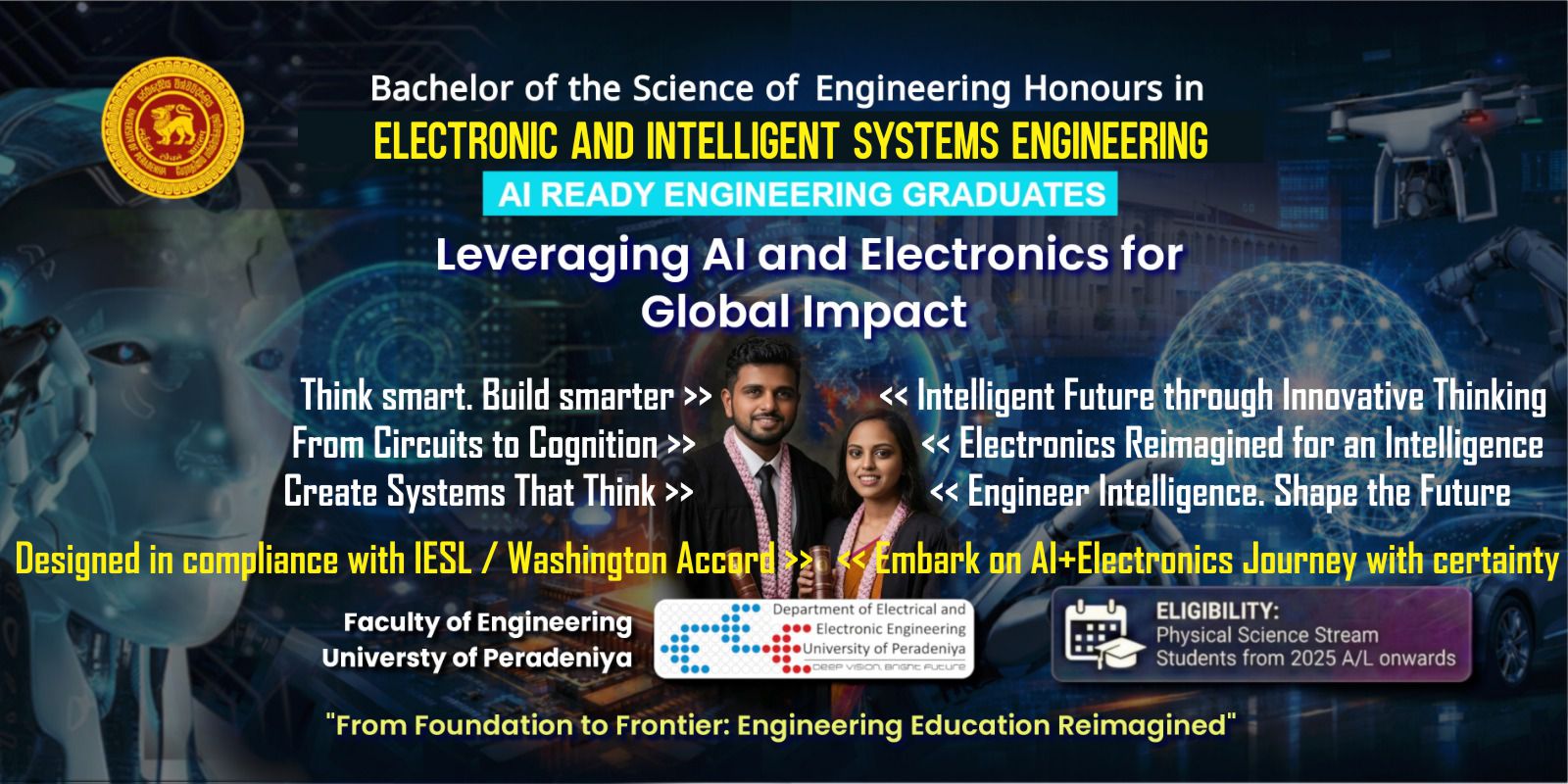
A Future-Ready Honours Engineering Degree for Intelligent Systems Innovation
Engineering is entering a defining era—one shaped by intelligent physical systems that can sense, learn, and act autonomously in complex environments. While robotics captures public imagination, this transformation is fundamentally reshaping sectors such as telecommunications, biomedical engineering, autonomous systems, smart energy, and advanced industrial technologies.
A critical insight underpins this shift: AI, in isolation, is not sufficient. The future demands engineers who can integrate intelligence into physical systems—combining AI with electronics, communications, power, and control to create solutions that function reliably in the real world. The emerging global need is clear: AI-embedded engineers with deep engineering foundations.
This Honours Engineering Degree has been conceived in direct response to this need. It is designed for students who aspire not merely to understand technology, but to engineer it at the highest level—through a curriculum that progressively challenges you to design, build, and realize intelligent systems of increasing sophistication.
The program draws on Peradeniya University’s over seventy years of academic excellence and leadership in Engineering education in Sri Lanka. It is positioned to produce graduates who are competitive at the frontiers of global industry and advanced study, for decades well into the future.
The delivery of this program is supported by newly established laboratories and advanced facilities within the recently expanded department complex.
Eligibility
Open exclusively to students from the Physical Science stream (GCE A/L 2025 onwards).
- Combined mathematics
- Physics
- Chemistry
Why Should You Apply?
A Distinct Advantage
This program offers a clear and focused academic trajectory from the outset.
Unlike the conventional pathway—where entry into specific engineering streams depends on first-semester university performance—this program enables you to commence immediately in a specialized, future-oriented domain.
For high-performing students with clarity of purpose, this represents an opportunity to move ahead with direction and momentum, rather than uncertainty.

Program Structure
The EISE program has been developed in line with the academic quality assurance and outcome-based education principles associated with IESL accreditation and the Washington Accord framework. It is designed for completion within four academic years. Each academic year has 2 semesters of 15 week duration.
Frequently Asked Questions (FAQ)
B.Sc.Eng.Hons. in Electronic and Intelligent Systems Engineering
NO.
⮚ This is a full honors engineering degree (BScEngHons), comparable to programs offered at the University of Peradeniya, Moratuwa, Ruhuna, Jaffna, South Eastern, and Sri Jayewardenepura.
⮚ Difference: Students enter directly into the Electronics + AI stream from semester one, ensuring early focus, continuity, and deeper expertise in a rapidly evolving field.
Yes. The program has been designed with due consideration to the academic and professional requirements expected for Engineering practice in Sri Lanka.
Under the current regulatory framework in Sri Lanka, registration with the Engineering Council Sri Lanka (ECSL) is linked to eligibility for Associate/Corporate Membership of the Institution of Engineers, Sri Lanka (IESL), which is the recognized professional body for engineers in the country. As stated in the ECSL FAQ and registration framework (https://www.ecsl.gov.lk/list-all-faqs), graduates who satisfy the recognized academic requirements and subsequently obtain the appropriate category of IESL membership are eligible for ECSL registration.
The EISE program has been developed in line with the academic quality assurance and outcome-based education principles associated with IESL accreditation and the Washington Accord framework. The Faculty offers the long-established BSc Engineering Honours program with six specializations, including Electrical and Electronic Engineering. With a history spanning more than 75 years, it is among the first engineering programs in the country to have undergone accreditation under internationally recognized standards. Our graduates have been admitted to leading universities worldwide and have secured positions in globally recognized industries. The EISE program is being delivered within the same academic environment, quality assurance framework, engineering infrastructure, and academic culture that have supported this internationally recognized engineering education tradition.
Accordingly, the program is structured to satisfy the academic pathway expected for professional engineering recognition through the IESL–ECSL framework, enabling graduates to pursue lawful engineering practice in Sri Lanka, subject to the professional requirements applicable at the time to engineering graduates of universities across the country.
Completely different.
⮚ It is a true engineering degree, not a general AI technology course.
⮚ Integrates Electronic Engineering fundamentals such as hardware design, circuit theory, signals, telecommunications, robotics, energy systems, biomedical engineering, and quantum sciences, with AI, Machine Learning, and next-generation intelligent technologies.
⮚ Entry is limited to A/L Physical Science students (Combined Maths, Physics, Chemistry)—same as conventional engineering pathways.
The new program is designed to meet the demands of a rapidly evolving global engineering landscape, including:
⮚ Artificial Intelligence, Machine Learning, and intelligent autonomous systems
⮚ Edge AI, smart devices, and embedded intelligence implemented on electronic platforms
⮚ Advanced electronic systems integrating intelligent sensing, computation, communication, and real-time control
Key differences:
⮚ AI is embedded from the first year.
⮚ Students gain a strong foundation in Electronic Engineering fundamentals, including hardware design, circuit theory, signals, telecommunications, robotics, energy systems, biomedical engineering, and quantum sciences, together with AI, Machine Learning, and next-generation intelligent technologies.
⮚ Focus on designing intelligent electronic systems that integrate hardware, software, and AI.
⮚ Exposure to modern industry tools and practices.
Graduates will be equipped to design systems that can sense, learn, and make decisions, skills increasingly demanded worldwide. Industry partners are already providing real-world exposure to prepare students for tomorrow’s engineering challenges.
Do not rely on rumors.
⮚ Misunderstandings are common for new, interdisciplinary programs like this.
⮚ Verify facts via official sources, program coordinators, or faculty of University of Peradeniya.
⮚ Contact the program team for accurate guidance—make decisions based on facts, not hearsay.
⮚ Refer to the official University of Peradeniya website and program coordinators.
Every new academic program attracts curiosity and discussion online. Questions on forums or social media are natural but often based on rumor or misunderstanding.
Unlike these informal discussions, the program is:
⮚ Designed by experienced academic staff.
⮚ The Faculty of Engineering and Department of Electrical and Electronic Engineering (DEEE) brings decades of experience in engineering education, having offered Sri Lanka’s first Electrical and Electronic Engineering degree program since 1950.
⮚ Aligned with global trends in AI and intelligent systems and IESL/Washington Accord Guidelines.
⮚ Supported by industry partners for real-world exposure.
Do you have further questions?
-
Address
Dept. of Electrical and Electronic Engineering
Faculty of Engineering
University of Peradeniya
Peradeniya, 20400 -
Telephone
+9470 3393400 (Dr. Isuru Dasanayake)
FINAL NOTE |
If you are passionate about electronics and intelligent technologies, this program offers a unique, future-focused opportunity not available elsewhere in Sri Lanka. |
Rather than following a conventional path, you will be shaping the next generation of engineering innovation. |